

by Margarida Farinha and Aleksandra Semeriak
In 2023, Statefree initiated a research fellowship that offered a much-needed insight into the practical barriers stateless people face in Germany, one of the many countries still lacking a statelessness determination procedure (SDP). The findings not only provided more visibility to the issue but also underscored the need for urgent actions: while we continue advocating for the implementation of an inclusive SDP in the country, we must already act to support people navigating this unknown pathway to recognition.
Two years later, at the Statelessness & Innovation Conference, jointly organised with the European Network on Statelessness (ENS) in November 2025, we were proud to publicly introduce our tool in the making: the Statefree Case Assistant, an idea that emerged out of necessity and has since been shaped and co-designed together with our valuable community impacted by statelessness.
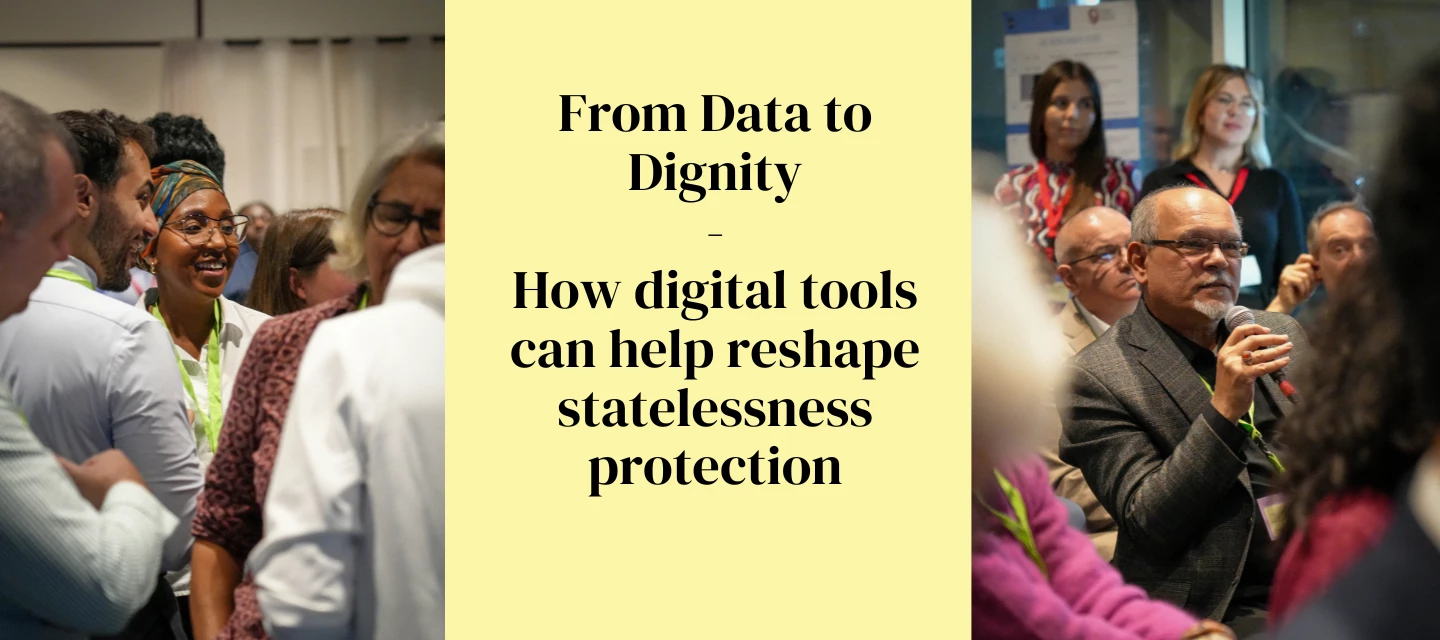
During the conference, our Innovation Lab “From Data to Dignity: Tech Solutions for Stateless Communities” brought together practitioners, researchers, tech experts and community members to explore how digital innovation can strengthen access to rights, documentation and dignity for stateless people.
Digital innovation is a broad concept. And digital solutions can vary widely in scope, purpose and technical complexity. ENS’s flagship tool, the Statelessness Index, covering 44 European countries, was collaboratively created to make reliable, comparable and accessible information available in a field where data has long been scattered or difficult to access. Likewise, the Statelessness Caselaw Database, a growing repository of nearly 400 judicial decisions, developed in collaboration with ENS Members and pro bono law firms, shows how litigation can be a key pathway for change, especially where policy reform moves slowly.
The Statefree Case Assistant aims to be part of this growing ecosystem of digital tools addressing statelessness. It is not an SDP but it sets the stage for developing a framework that supports stateless people in structuring their case and navigating the complex journey of status determination and to mitigate the feeling of being alone in the process. This sentiment, voiced by a formerly stateless person during the session, captures how digital spaces can address the profound isolation that often defines statelessness in non-inclusive systems.
To better understand how this can be achieved from a technical point of view, our Head of IT and Digitalisation shared “a look under the hood”: a progressive security architecture, KERN UX standard for public-sector applications and a modular, open-source framework that ensures adaptability and digital sovereignty. With clear requirements, multilingual planning and a “security by design” approach, the Case Assistant is envisioned to be not only a practical tool for stateless individuals in Germany, where it will be piloted next year, but also a model that could support people in countries where no SDP exists and where uncertainty, lack of structure, opacity and fear dominate the process of gathering the right evidence to be recognised as stateless.
Digital tools such as the Index, the Caselaw Database and the Case Assistant complement each other to respond to the diverse gaps and to navigate the unstructured scenarios with greater clarity and agency. Our conference session was only a preview of their potential. The input and questions collected from participants will inform our next steps, and, as the Case Assistant evolves, Statefree remains committed to co-developing a digital pathway that not only structures complexity but also centres dignity, community knowledge and intersectional accessibility.
More updates will follow soon. If you’d like to follow the journey of the Statefree Case Assistant, don’t forget to register here. This is just the beginning!