
At this year’s Statelessness & Innovation: Building Power Through Collective Action conference, one question echoed through the auditorium: What does protection look like when it truly works — and who is responsible for making it happen?
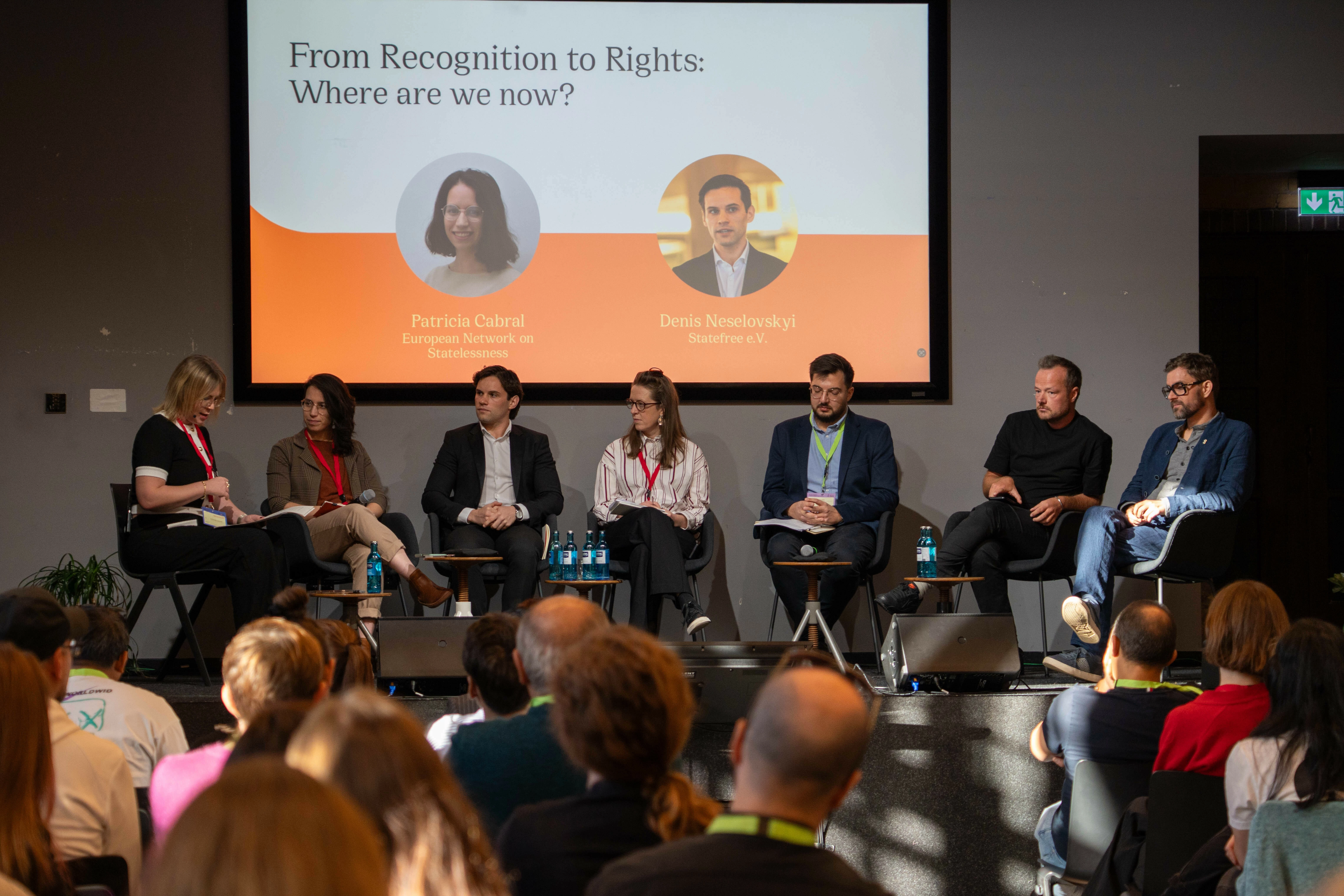
The session “From Recognition to Rights: The Future of Statelessness Protection in Europe” brought together practitioners, advocates, community members, and institutional actors from Germany, the Netherlands, Czechia, and across Europe. What emerged was not just a comparative overview of systems, but a sharper understanding of why so many people remain unprotected — and what it will take to change that.
The Central Fault Line: Identification
Early reflections from the Statelessness Index briefing set the tone. Across Europe, the landscape is full of promising practices — stronger data collection, clearer local initiatives, developing procedures — yet the same structural weakness repeats itself everywhere:
Recognition alone does not guarantee rights. Identification is the missing link.
Participants recognised this not as a technical detail but as the defining barrier. Without a dedicated procedure, the system simply does not see people who need protection — and what is invisible cannot be safeguarded.
Germany stands as the clearest example. The absence of an SDP is not an administrative oversight; it produces real, measurable consequences. People move between authorities without a clear point of responsibility, rely on discretionary decisions, and spend years in limbo. In a country with the capacity and expertise to design an effective mechanism, the gap is increasingly indefensible.
Where Leadership and Innovation Are Emerging
Despite these systemic shortcomings, the session made one thing clear: innovation is happening — often from the ground up.
- Local leadership in the Netherlands shows how municipalities can build protection-oriented practices even without perfect national frameworks.
- Strategic litigation in Czechia demonstrates how targeted legal action can force institutions to align with international standards.
- ENS tools and guidance help practitioners understand when statelessness is at play, ensuring that cases do not fall through procedural cracks.
- The Statefree Case Assistant offers a practical, scalable solution for navigating documentation, appointments, and communication with authorities — reducing confusion for both applicants and institutions.
None of these examples claim to be full solutions. But together, they show that progress grows wherever actors take responsibility instead of waiting for structural reform.
A Shift Toward Collective Responsibility
The co-creation segment pushed the conversation from observation to ownership. Participants named barriers with striking clarity: unclear processes, siloed decision-making, missing partnerships, limited awareness among frontline officials, and the ongoing tension between person-centred and process-centred systems.
Yet they also identified opportunities — from community-institution collaboration to better use of European tools to cross-border learning between practitioners.
At the “ideas wall,” a pattern emerged: We know what is missing. We also know what works. The real question is: who takes the next step?
From Insight to Action
The session closed with a commitment round — not symbolic, but specific. Participants were asked to name one action they or their organisation would take after the conference. Some pledged to introduce internal reforms; others committed to new partnerships or to advocating more forcefully for a dedicated procedure. Many emphasised elevating lived experience as core expertise.
These commitments reflect the essence of the session:
Protection is not something Europe needs to reinvent. It is something we need to operationalise — consistently, collaboratively, and with accountable institutions.